
Criminal Cases in the Cannon County Courts
Cannon County criminal cases can occupy two local court levels. General Sessions Court handles misdemeanors within its authority, traffic and criminal matters, initial appearances, bond, and preliminary hearings in felony cases. The official Tennessee judge directory identifies the Cannon County General Sessions judge. If a grand jury returns an indictment, the felony proceeds in Circuit or Criminal Court within Tennessee's 16th Judicial District. Cannon and Rutherford Counties share that district, so a judge, lawyer, or program office may have a Rutherford County address while the case itself remains a Cannon County prosecution.
The Cannon County Circuit Court Clerk maintains General Sessions Criminal and Circuit Criminal filings. The same office processes filings and final dispositions through the case stages. That makes the clerk the right custodian for a docket number, filed charge, judgment, disposition, or certified court copy. A jail booking sheet cannot answer those questions.
Cannon County Circuit Court Clerk
200 West Main Street
Woodbury, TN 37190
615-563-4461
Call first to confirm counter hours, file location, copy cost, payment method, and delivery options.
Search Cannon County Docket PDFs
The county's Criminal Circuit Court docket page publishes documents by court session or date. It is a free calendar index, not a party-name database. Open the likely PDF and use the browser's find tool when the text is searchable. Scanned documents may not respond to text search. A posted docket can show a case number, caption, judge, attorney, charge shorthand, or scheduled event, but a calendar may change and does not contain the whole Cannon County court file.
The Tennessee appellate Public Case History becomes relevant only if a Cannon County case reaches an appellate court.
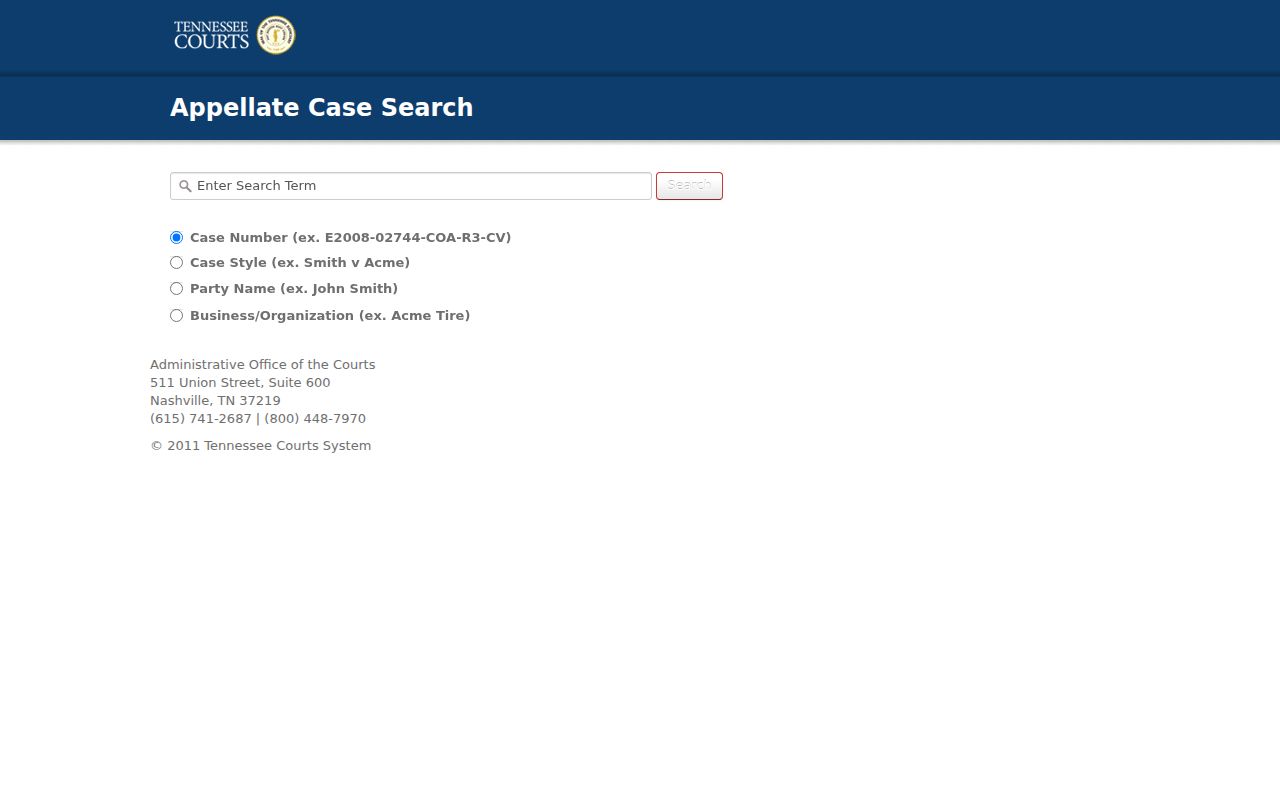
This interface is an appeal layer, not a substitute for the General Sessions or Circuit Criminal records kept in Woodbury.
Note: Absence from one Cannon County docket PDF does not establish that no criminal case exists.
How to Search Case Records
Use a posted docket to collect clues, then ask the clerk for the actual file. Name spelling, an approximate filing or arrest year, and a docket number are useful. Share a date of birth only through a secure channel the clerk approves. No current Cannon County copy or certification fee schedule was found in the official sources, so request a quote before ordering.
- Open the county docket page and choose a likely criminal court session.
- Search an accessible PDF for the name or scan the calendar entries.
- Record the docket number, court level, hearing date, and case caption.
- Call 615-563-4461 and request searches of both General Sessions Criminal and Circuit Criminal.
- Ask for the final disposition, judgment, and a quote for plain or certified copies.
| Field or Control | Type | Required | Use |
|---|---|---|---|
| Docket document | PDF link | No input | Choose by posted session or date |
| Browser find | Local tool | Optional | Works only when PDF text is accessible |
| Name or case search | Not offered | N/A | Contact the clerk for a file search |
| Open or download | PDF control | Optional | View the posted calendar at no charge |
If no posted document fits, skip assumptions and call the clerk. Ask whether the name appears in an older file, a General Sessions matter, or a newly filed case that has not reached the publication page. The clerk can also explain which delivery methods are currently offered. When the question is only about intake or present custody, use the official Cannon County Sheriff's Office instead. That office and the jail hold booking records, while the clerk holds the criminal case record.
Cannon County Court Levels Compared
General Sessions and Circuit Criminal records cover different phases. A misdemeanor may remain in General Sessions. A felony accusation may begin there with an initial appearance, bond decision, and preliminary hearing, then move to Circuit or Criminal Court after indictment. Search both levels when the record trail is incomplete. The Tennessee court listing for Cannon County confirms the courthouse as the local home for Circuit, Criminal, and Chancery functions.
The official clerk directory entry supplies the court contact, address, phone, and email. Older files or unposted General Sessions records may require a counter, mail, or other delivery method approved by the clerk. The state Recovery Court program directory documents the District 16 program serving Cannon and Rutherford. Participation alone does not prove dismissal or expungement. Only the judgment and any later expungement order establish that outcome.
What the Case File Shows
A Cannon County case file traces what prosecutors filed and what the judge did. It may include the complaint or warrant, bond orders, preliminary-hearing entries, an indictment, motions, plea papers, trial events, a judgment, sentence, probation terms, violation proceedings, costs, and appeal notices. Availability depends on public status, retention, digitization, and the clerk's copy policy.
| Case Number & Court | Identifies the local docket, division, filing date, judge, case type, and status. |
|---|---|
| Charging Document | Shows counts, cited law, offense class, and any amended charge actually filed. |
| Docket Entries | Chronicles filings, returns, hearings, motions, pleas, trial activity, and later violations. |
| Hearing Dates | Lists the date, time, place, judge, and event type when public. |
| Disposition & Judgment | Records dismissal, nolle, acquittal, plea, verdict, and the court's final order. |
| Sentence & Conditions | May state confinement, probation, costs, restitution, jail credit, and concurrent or consecutive treatment. |
Read the entries in sequence. The charging document shows the accusation actually placed before the court, while later entries show amendments, hearings, pleas, rulings, and sentence terms. A docket may display costs or balances, but the clerk should confirm the current amount and whether a financial entry is public. Protected personal data can be redacted even when the rest of the Cannon County case remains open to inspection.
Read Cannon County Case Outcomes
Disposition terms prevent a charge heading from being mistaken for the final result. Dismissed means the court ended that charge without a conviction. Nolle prosequi, often shortened to nolle, reflects a prosecution decision not to proceed at that time. Acquitted or not guilty is a ruling for the accused. A guilty plea to a lesser charge means the conviction differs from the original booking or filed allegation.
- Diversion
- Conditions may lead to dismissal, but completion is not itself proof that all public records were deleted.
- Certified judgment
- A clerk-certified final court record that is stronger evidence of outcome than a calendar or repository summary.
- Missing disposition
- An incomplete outcome field that should trigger a clerk inquiry, not a guess that the matter is still pending.
When the clerk's judgment and TBI history disagree, use the certified Cannon County disposition to seek correction. This is why the court file matters even when TORIS displays a state repository record.
Stages of a Criminal Case
The local path depends on the filed charge. General Sessions handles the early court work and many misdemeanors. A felony that survives the preliminary stage can go to the grand jury and, after indictment, to Circuit or Criminal Court. Motions and negotiations may alter the filed counts before a plea or trial. The judgment then states the disposition and sentence.
Case flow: Charges Filed › Arraignment › Pretrial › Plea or Trial › Disposition › Sentencing
Booking comes before this court sequence but belongs to the sheriff or jail record. Readers following the accusation from intake can consult the county's arrest history channels, then return to the clerk for the filed charge and outcome.
Certified Cannon County Judgments
A docket calendar answers what was scheduled. A certified judgment answers what the court ordered. Ask the clerk for certification when the exact outcome, sentence, or amended charge matters. Give the docket number if known and specify whether the request covers General Sessions Criminal, Circuit Criminal, or both. Ask whether the file is onsite and how plain-copy and certified-copy costs differ.
Keep certified orders used to correct a Tennessee repository entry or document an expungement. A repository can lag after the court acts. The clerk's final order supplies the strongest local proof while agencies process the change. The same rule applies to Recovery Court: program entry or completion is not a substitute for the filed disposition.
Note: Request the judgment and disposition, not only the docket sheet, when the final Cannon County result is the goal.
Access & Restrictions
Tennessee court records are generally open, but access has limits. Tennessee Supreme Court Rule 34 recognizes public case records while protecting sealed documents, judicial drafts and deliberative notes, protected information, and records whose release would interfere with court functions. Statutes and court orders can also restrict juvenile, victim, medical, and personal identifying data.
The official Rule 34 source shows how statewide access rules shape Cannon County criminal case copies.
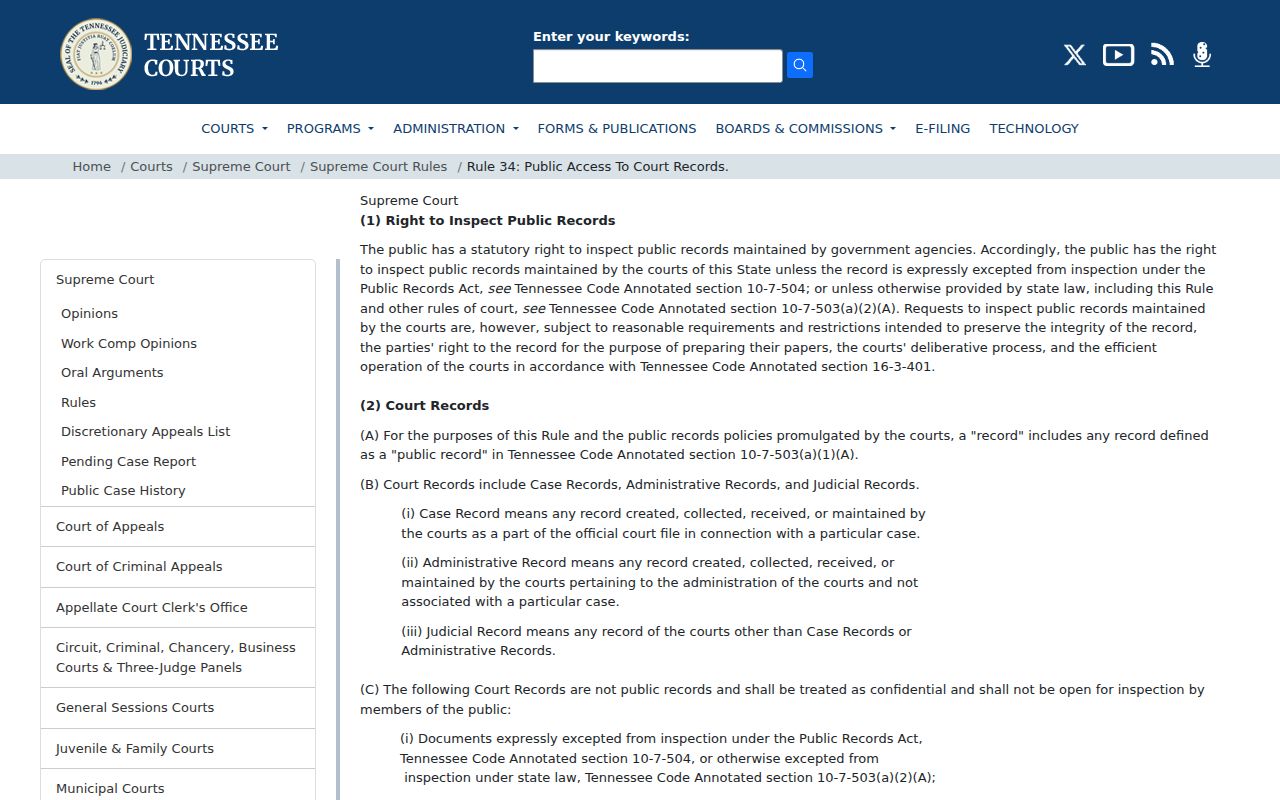
Redaction or the lack of an online result does not mean the whole Cannon County court file is closed. Ask the clerk which public portions can be inspected or copied and what authority governs any denial.
Cannon County Appeals and Federal Cases
A state appeal leaves the Cannon trial-court search path and enters Tennessee Public Case History. A federal prosecution is different from a Cannon County prosecution. Cannon lies within the Middle District of Tennessee, while PACER supplies federal docket and document access. Search the local clerk first unless the case caption or papers show an appellate or federal court.
The official PACER service explains federal account access and records.
PACER does not contain the Cannon County General Sessions or Circuit Criminal file.
The separate PACER Case Locator helps identify the federal court and case number.
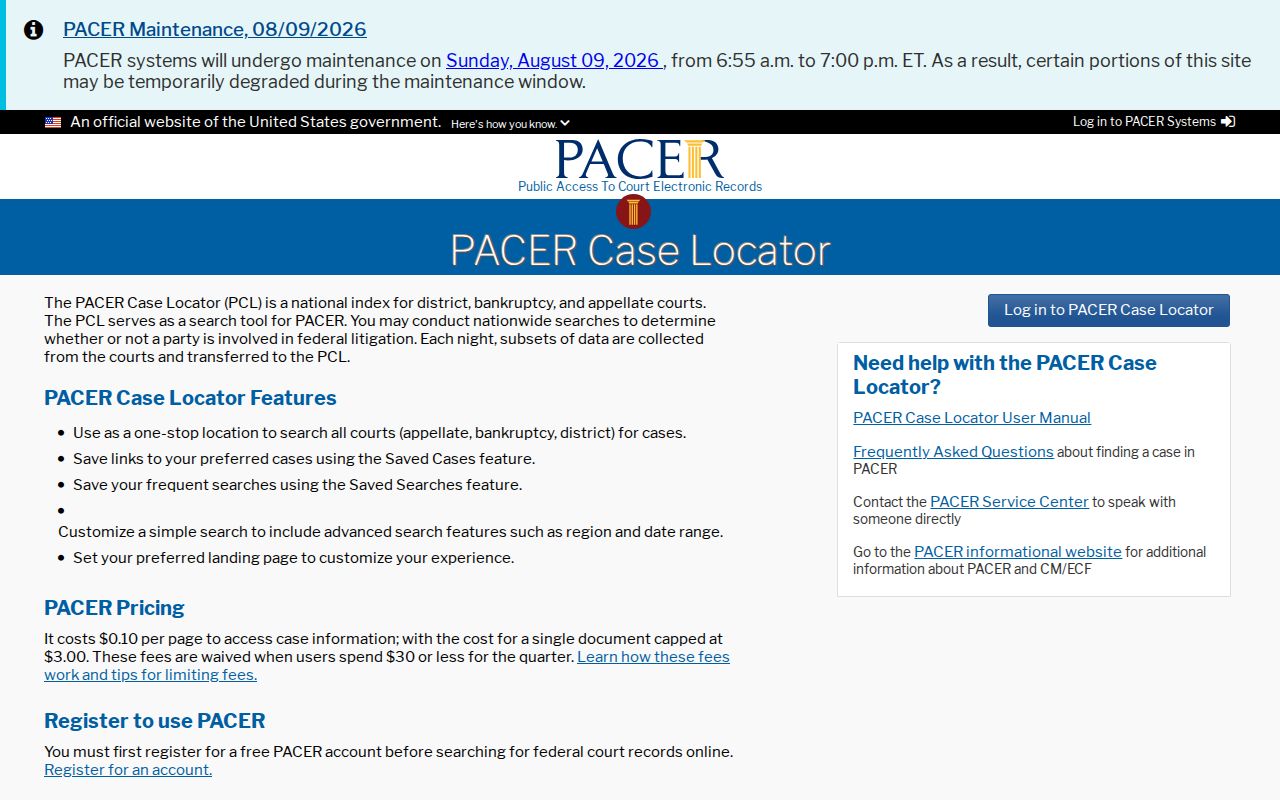
Once a federal match is found, use the assigned federal district docket rather than asking the Cannon clerk for federal filings.
The Middle District of Tennessee is the federal district covering Cannon County.
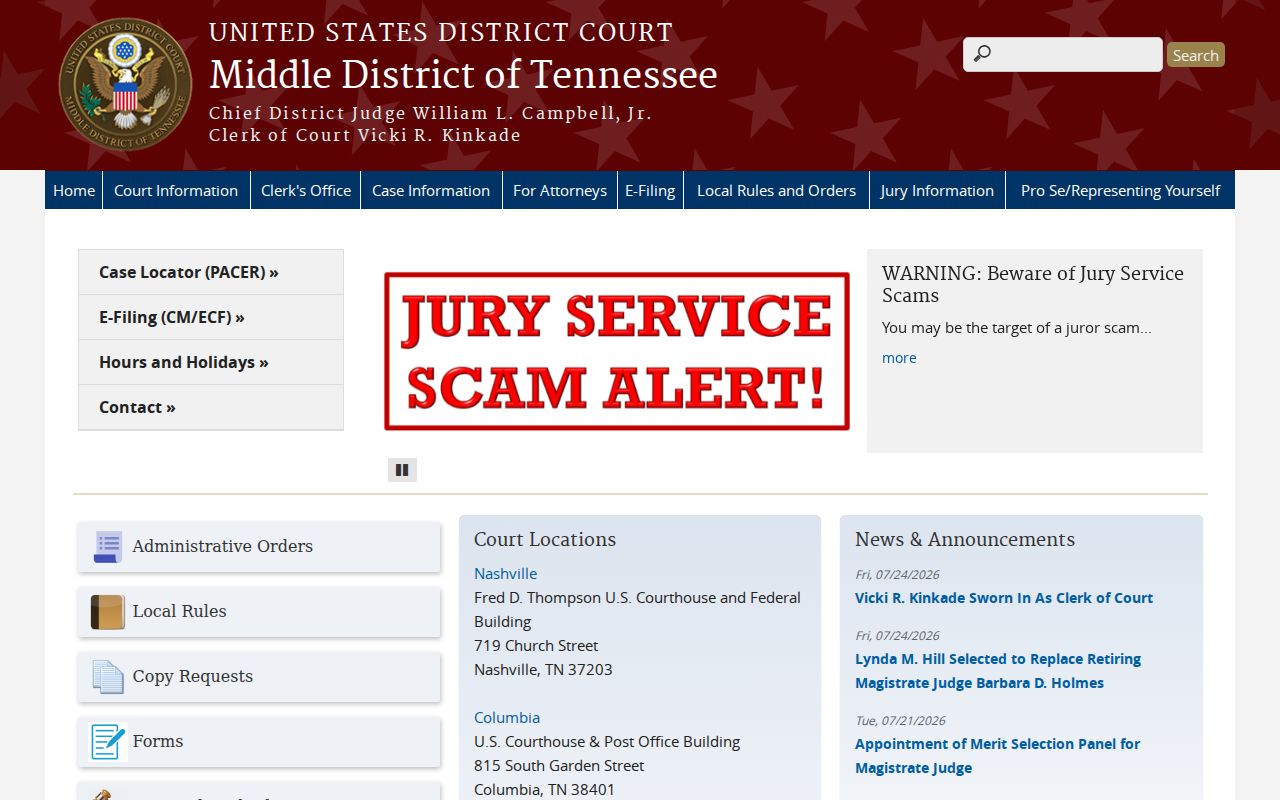
The U.S. Attorney for the Middle District of Tennessee prosecutes federal cases, while the U.S. Marshals Service district office handles federal custody and warrant functions. This federal court layer is narrow and distinct. Local charges, dispositions, and certified judgments remain with Cannon County's court clerk.