
How to Check Criminal History in Cannon County
No single Cannon County search answers every record question. Start with the Circuit Court Clerk when the goal is a filed charge, judgment, sentence, or certified disposition. The county posts selected Criminal Circuit Court docket PDFs, but those files are calendars, not a full name-search database. General Sessions Criminal and Circuit Criminal records may require separate clerk searches. Very recent custody belongs with Cannon County Jail, while a sheriff-created incident or arrest report belongs with the Sheriff's Office records custodian.
Before calling or visiting, gather the full name, spelling variants, an approximate date, and any docket, incident, or booking number. A date of birth may help distinguish common names, but send sensitive identifiers only through a channel the office accepts. Then follow the record from its first custodian to the court outcome:
- Review the county's posted Criminal Circuit Court docket documents for a likely session or docket number.
- Ask the clerk to check both General Sessions Criminal and Circuit Criminal records for the name and time period.
- Contact the jail for current custody, or the arresting agency for its report and supporting media.
- Use TORIS for Tennessee's repository view and FOIL only for felony custody or supervision.
- Compare the charge, agency, date, and disposition, then order a certified court copy when proof is needed.
No Search Box for Cannon Records
Cannon County does not publish a comprehensive local criminal-record database, public jail roster, booking blotter, or active-warrant name search. That absence is a reason to use the fallback chain, not proof that no record exists. The county department directory routes readers to the clerk and sheriff. A phone inquiry can identify the right custodian, but a precise written Tennessee Public Records Act request is better for a complex report, recording, photograph, or set of files.
The official Cannon County department landing page shows how local record services are arranged.
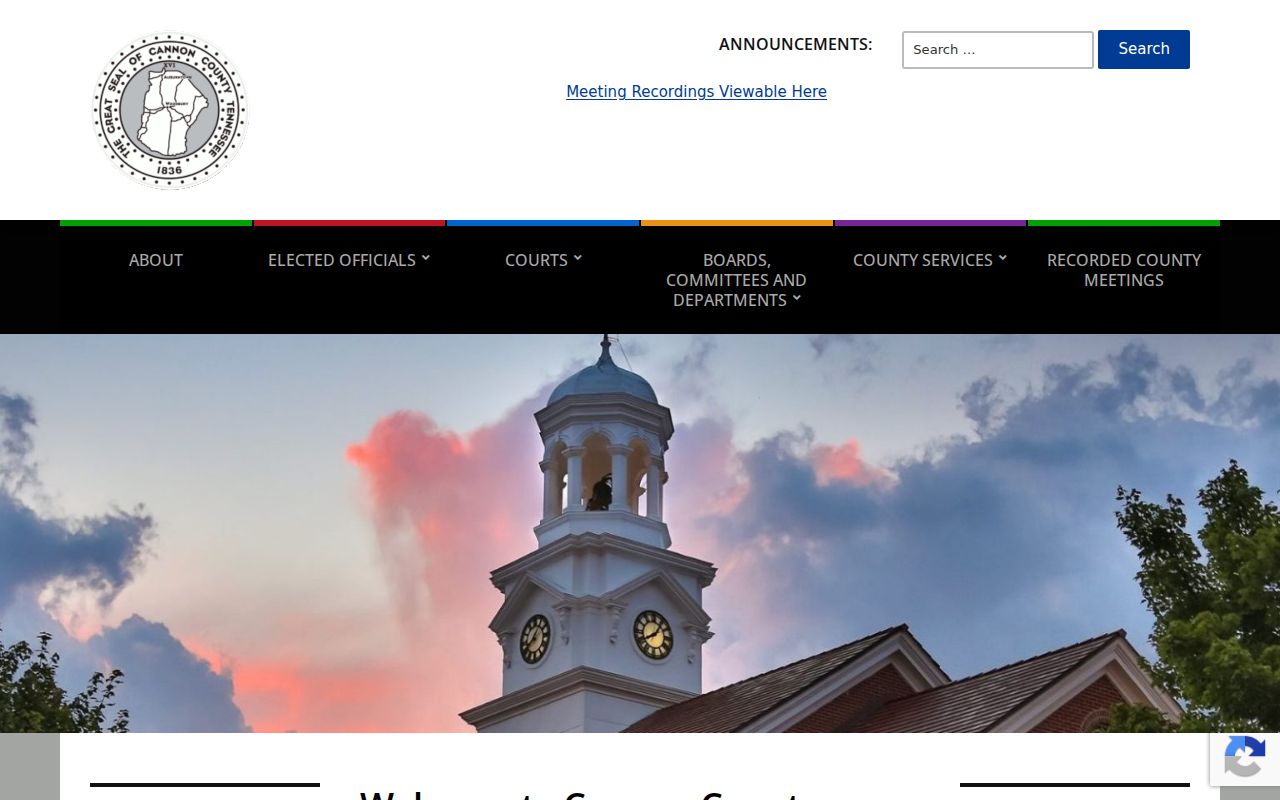
That department structure matters because Cannon records stay with the office that made or filed them. A request should identify the agency, record type, incident or case number, date range, location, involved names, desired format, and whether inspection, copies, or certification are sought. Tennessee agencies generally must provide prompt access or, within seven business days, issue the record, deny it with authority, or explain the time and cost needed. The law does not require an office to create a new report to answer a question.
Official Tennessee Background Checks
The Tennessee Bureau of Investigation, Criminal Justice Information Services Division, holds the central fingerprint-supported criminal-history repository. Its public product is Tennessee Open Records Information Services, or TORIS. For self-review, any Cannon County requester may order a Tennessee name-based Open Records check for $29. The charge is nonrefundable, the request does not include aliases, and most juvenile data is excluded. A possible match returns a copy of the Tennessee history linked to the supplied name, not a certified Cannon County case file.
For an authorized fingerprint check, follow TBI Applicant Processing Services directions and schedule capture through IdentoGO by IDEMIA. The correct service code comes from the law or program that requires the check, so it should never be guessed. A person reviewing their own national FBI information can instead use the FBI Identity History Summary process. Each product has a different scope.
| Official channel | Scope | Input and cost |
|---|---|---|
| TORIS | Tennessee repository history | Name and order details; $29, nonrefundable |
| TBI / IdentoGO | Authorized fingerprint check | Service code, ID, fingerprints; fee varies |
| FBI Identity History Summary | Subject's national FBI identity history | Application, identity, payment, and fingerprints |
| Cannon County clerk | Local court case and disposition | Name, year, or docket; local fees not posted |
Cannon County TORIS Record Limits
The TORIS portal first asks whether the user will continue as a credit-card customer or sign in with a billable account. Card customers can use Visa, MasterCard, or Discover. TBI recommends a desktop or laptop because a result PDF may not display well on every device. The subject-name and identity prompts appear later in the paid order flow, so live labels should be followed as displayed instead of assumed in advance.
The captured official TORIS entry screen shows those customer routes and the current fee notice.
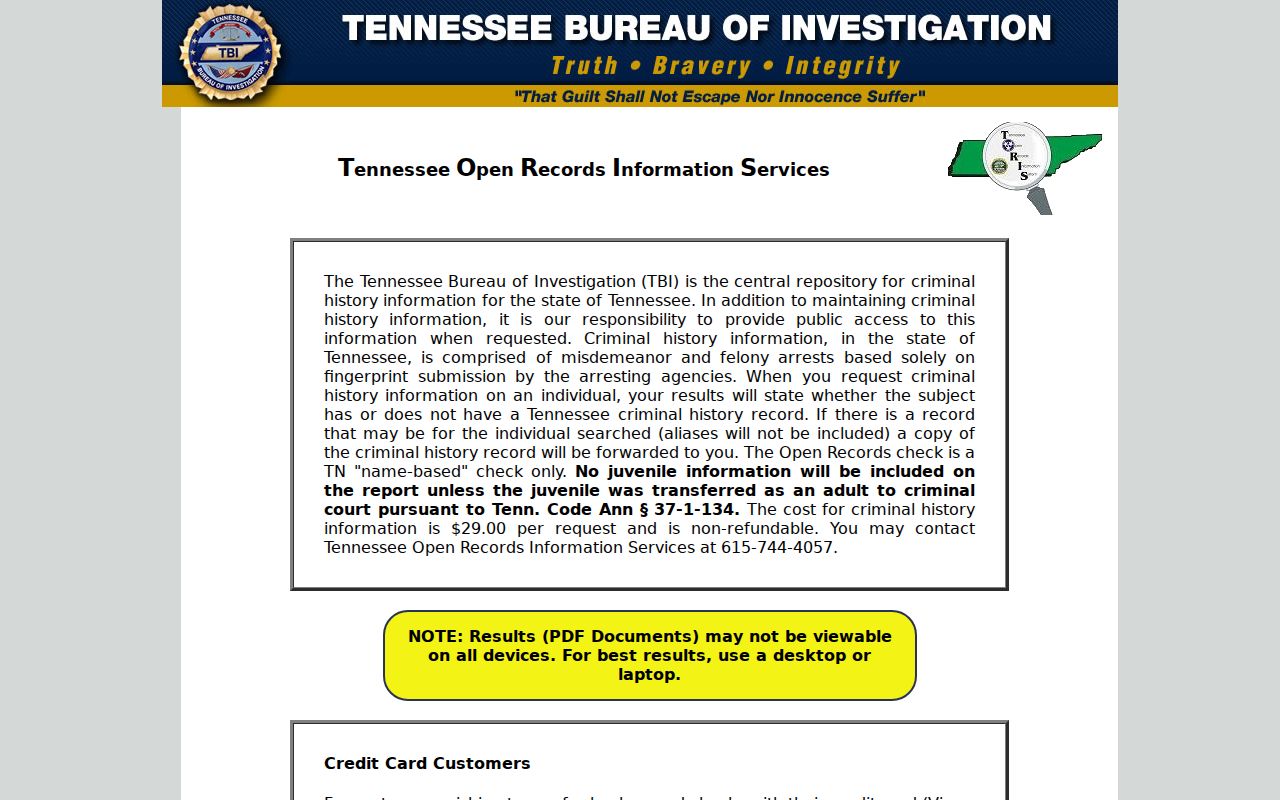
For a Cannon County record check, a TORIS result can lag behind the court file if a disposition has not reached TBI. It can also miss an alias that was not part of the name request. Match the arresting agency, arrest date, charge, and identifiers, then verify the final outcome with the clerk. A result is strongest when read beside a certified judgment rather than as a stand-alone answer.
| Field or control | Type | Required | Options and format notes |
|---|---|---|---|
| Credit Card Customers: Continue | Button | Yes for guest card route | Advances to the $29 request workflow |
| User Name | Text | Yes for billable account | Account route only |
| Password | Password | Yes for billable account | Account route only |
| Subject name | Text inputs in order flow | Yes | Name-based check; aliases are not included |
| Identifying details | Order-flow inputs | As marked live | Accurate details help separate similar names |
| Payment | Card | Yes for card customer | Visa, MasterCard, or Discover; nonrefundable |
Types of Criminal Records
Each Cannon County record describes a different stage. An incident report documents an agency's response and may exist without an arrest. An arrest report states the officer's alleged basis, while the jail's booking entry records intake, bond, holds, and release. The clerk's criminal case file shows what prosecutors filed and how the court ruled. TBI then assembles fingerprint-supported arrest cycles and reported dispositions into the state repository.
Other systems answer narrower questions. A warrant authorizes an arrest or search but must be confirmed with the issuing court or sheriff. TDOC's FOIL service describes current or former felony custody and supervision, including some probation, parole, or inactive status. TDOC also places FOIL in the MyTN Public Safety tools and points to VINELink for participating custody notifications. Neither route exposes an officer's case notes or every supervision condition. The Tennessee Sex Offender Registry is a separate legal registration system updated from registering-agency submissions. Keep these terms distinct:
- Booking record
- The Cannon County Jail intake record, including booked charges and custody facts.
- Case file
- The clerk's pleadings, docket events, judgment, costs, and final disposition.
- Repository history
- TBI's identity-linked collection of fingerprint arrests and reported outcomes.
- FOIL record
- TDOC felony offender status, sentence, location, and release information.
- Disposition
- The court result for a charge, such as dismissed, nolle, acquitted, or guilty.
Cannon County Warrants and Police Reports
Cannon County has no official public active-warrant name search in the sources reviewed. An absent web result therefore says nothing about warrant status. Start with the Sheriff's Office for service and law-enforcement confirmation, then contact the issuing clerk for a bench warrant, capias, or court-linked warrant. Ask for the docket number, issuing court, current status, and whether the court has recalled or cleared the process. Sealed warrants, juvenile matters, and affidavits tied to an active investigation may not be public.
A person checking their own Cannon County warrant should ask about the correct appearance or surrender route and may wish to speak with a licensed Tennessee attorney before acting. Do not approach or attempt to detain another person. Only law enforcement and the issuing court can confirm an active warrant.
Police reports follow the officer's agency. Request a sheriff deputy's report at 110 Alexander Drive, a Woodbury-created report through the town custodian, and a Tennessee Highway Patrol crash through the Department of Safety. A useful request gives the report number, date, time, place, involved names, officer or agency, exact record sought, delivery format, and a fee cap. Ask for the separable public portions when victim, juvenile, medical, personal-identifier, video, or active-investigation material must be redacted.
Cannon County's Three Criminal Records
The most common mistake is treating a booking label, a filed charge, and a TBI entry as the same fact. They are three records made at different times. The arresting officer supplies an allegation. Jail staff create the intake entry. A prosecutor may later reduce, add, split, or decline charges. General Sessions Court handles initial proceedings and misdemeanors within its authority, while an indicted felony moves to Circuit or Criminal Court. The clerk then sends the disposition through the reporting chain to TBI.
The flow is direct: Officer report → Cannon County booking → charging decision → General Sessions proceedings → Circuit or Criminal Court after indictment → clerk disposition → TBI repository update. For Cannon County criminal history, the court disposition controls what happened in the prosecution. “Dismissed” means the court ended the charge without conviction. “Nolle prosequi,” often shortened to “nolle,” means the prosecutor chose not to proceed at that time. A guilty plea to a lesser charge means the conviction differs from the first booking label. A missing disposition calls for a clerk check, not a guess.
What a Cannon County Criminal Record Shows
A record's fields depend on its custodian. A Tennessee repository history may group information by arrest cycle and include the reported identity, date of birth, state identification number, fingerprint transaction identifiers, arrest agency, charges, codes, and a court disposition. The Cannon County court file adds the docket number, filing date, court, attorneys, motions, hearing events, judgment, sentence, and costs. FOIL has its own offender and supervision fields.
Tennessee class labels add context but do not predict a result. Under T.C.A. §40-35-111, felony classes A through E carry general ranges from 15 to 60 years at Class A down to one to six years at Class E. Misdemeanor classes A through C run from up to 11 months and 29 days down to 30 days. Offense statutes, ranges, enhancements, and alternative sentences can change the practical result, so read the final class and sentence in the Cannon County judgment.
| Name & Identifiers | Reported name, aliases already tied to the identity, birth date, photograph when available, physical description, SID, TDOC ID, or transaction number as applicable. |
|---|---|
| Arrest / Booking Data | Agency, arrest and intake dates, booking number, alleged charges, bond, holds, and release facts. |
| Charges & Statutes | Booked allegations, filed counts, Tennessee citations, class, and any amended or lesser charge. |
| Disposition | Dismissal, nolle, acquittal, plea, verdict, diversion result, or another court outcome. |
| Sentence | Offense, county, docket, confinement, probation, costs, sentence length and dates, plus concurrent or consecutive treatment when recorded. |
| Custody / Supervision | Jail status locally or FOIL's assigned TDOC location, supervision status, custody level, sentence dates, release eligibility, parole hearing result, or inactive status. |
Two Cannon County Record Addresses
Cannon County's records split across two Woodbury locations. The Cannon County Courthouse at 200 West Main Street is the practical counter for General Sessions Criminal and Circuit Criminal filings. Circuit Court Clerk Katina George's office can be reached at 615-563-4461 or katinageorge.cannoncircuit@gmail.com. Ask about current counter hours, copy charges, certification fees, and whether an older file is on site before traveling.
The official Tennessee court listing for Cannon County is the source for this courthouse view.
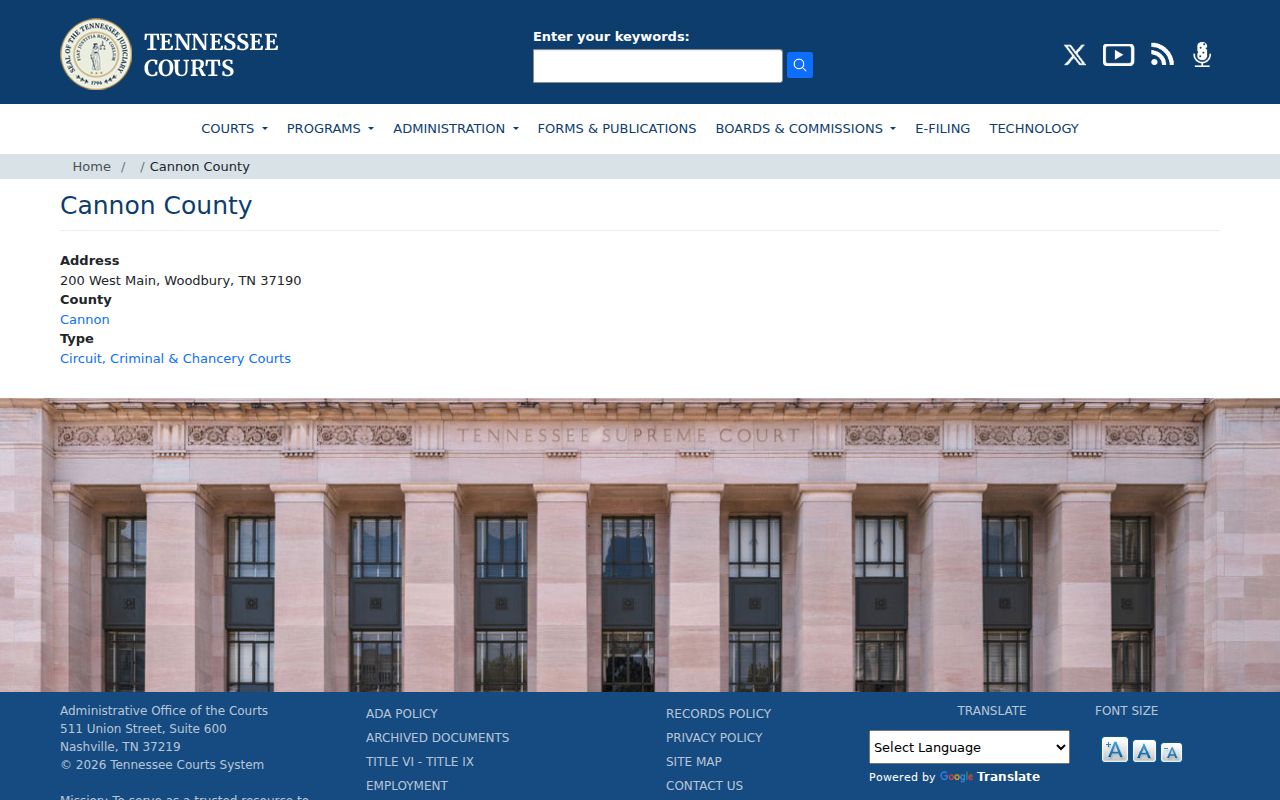
The courthouse is the place to confirm adjudication, meaning the court's decision. A posted docket may help locate a session, but the clerk holds the fuller file and can explain copy options.
The Sheriff's Office and Cannon County Jail share 110 Alexander Drive, Woodbury, TN 37190. Sheriff Darrell Young's office is the starting point for sheriff incident reports, booking information, present jail custody, served warrants, and local sex-offender registration questions. The county publishes 615-563-2320 as its contact number, but no dedicated jail line or public-counter hours were confirmed.
The official Cannon County sheriff page identifies the office and jail location.
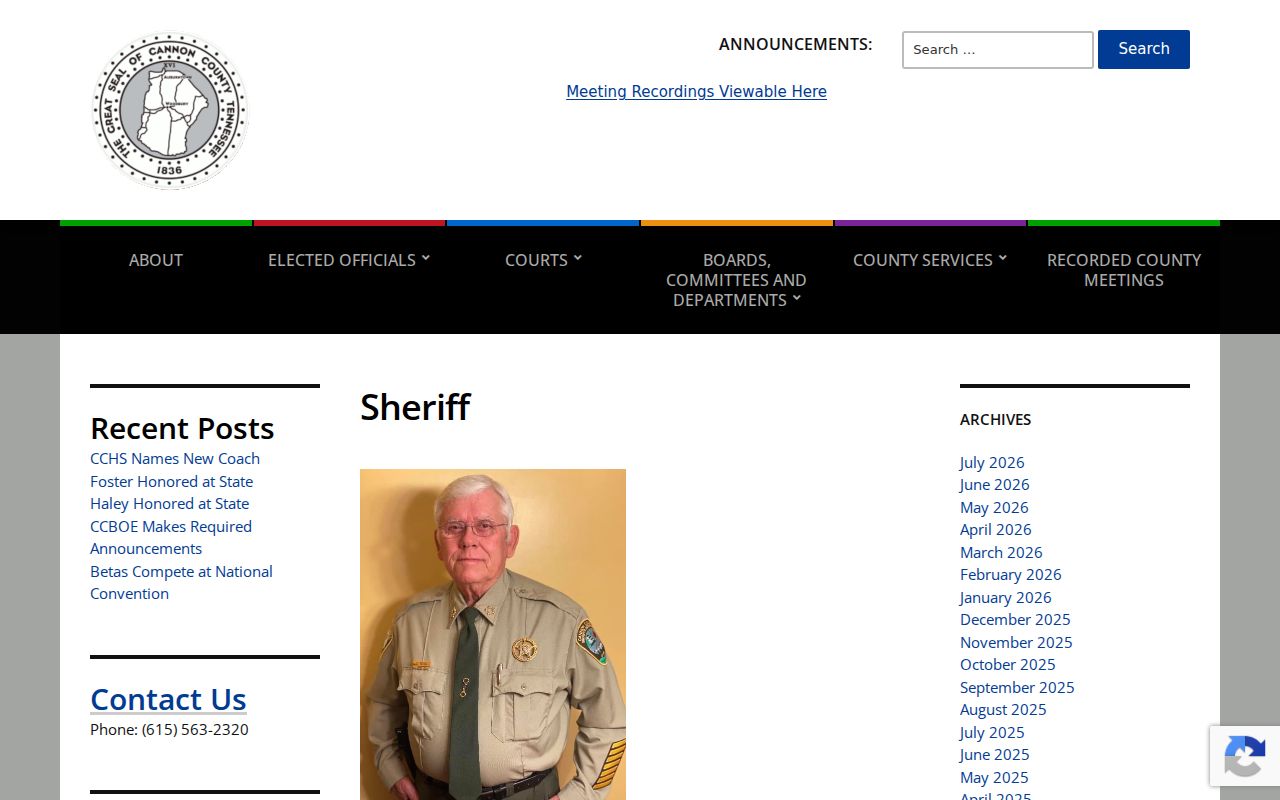
The two-address split keeps custody and adjudication apart. Ask Alexander Drive about intake and sheriff-created reports. Ask West Main about the charge filed, hearing history, judgment, and certified disposition.
Circuit Court Clerk
200 West Main Street
Woodbury, TN 37190
615-563-4461
General Sessions Criminal and Circuit Criminal files, dispositions, and certified copies.
Sheriff and County Jail
110 Alexander Drive
Woodbury, TN 37190
County contact: 615-563-2320
Sheriff reports, booking and custody details, warrants, and registration questions.
Cannon County Sentences and Supervision
Tennessee class labels set broad sentencing limits, but the Cannon County judgment controls the sentence actually imposed. Class A through E felonies move through Circuit or Criminal Court after indictment. General Sessions handles misdemeanors within its authority and preliminary felony stages. T.C.A. §40-35-111 supplies general ranges and fine ceilings, while the offense statute, plea or verdict, range classification, enhancements, jail credit, and concurrent or consecutive terms shape the final result. A Class E label alone does not establish expungement eligibility.
Probation and parole are not the same. A Cannon County court may impose probation as part of its judgment. The Tennessee Board of Parole makes parole decisions for eligible state prisoners, and TDOC Community Supervision supervises felony probation and people released on parole. District 50 serves Cannon County from the regional structure that includes Rutherford and other counties, so a Murfreesboro office can still be the correct supervision contact.
FOIL may show incarceration, probation, parole, or inactive status, an assigned location, sentence dates, and parole data. It does not reveal an officer's case notes or replace the certified Cannon County judgment. The Tennessee Board of Parole supplies the official parole layer, while the clerk remains the source for what the court ordered.
Public Access Laws
The Tennessee Public Records Act, chiefly T.C.A. §§10-7-503 and 10-7-504, governs access to many county and agency records. Tennessee Supreme Court Rule 34 governs public access to court records while protecting sealed files, judicial working material, system-security information, and records restricted by statute or court order. Juvenile, victim, medical, identity, and active-investigation information may be confidential or redacted. A denial should identify its legal authority.
Key authorities:
T.C.A. §§10-7-503 and 504 establish the TPRA access framework and its exceptions.
Tennessee Supreme Court Rule 34 sets access and restriction rules for state court records.
T.C.A. §40-32-101 controls qualifying expungement and the agency deletion process.
T.C.A. §§40-39-201 through 216 govern Tennessee registration, publication, restrictions, and violations.
The Office of Open Records Counsel offers guidance and mediation resources, but the best Cannon County request still names an existing record. Asking an office to explain events or compile facts can fail because TPRA does not require a new document. Ask instead for the report, docket entry, judgment, recording, or other item already maintained.
Cannon County Court Records in District 16
Cannon and Rutherford Counties form Tennessee's 16th Judicial District. District judges and the Adult Recovery Court can serve both counties, so a Murfreesboro office or program contact does not mean a Cannon County case belongs elsewhere. The Cannon County caption, docket, and Circuit Court Clerk remain the key local references. General Sessions Court handles misdemeanors within its authority, initial appearances, bond, and felony preliminary hearings. An indictment moves a felony into Circuit or Criminal Court.
The official Tennessee judicial district map shows the shared district.
This shared structure also explains why district programs may be coordinated outside Woodbury. Recovery Court participation is a specialty-court process, not automatic dismissal or expungement. Only the judgment and any later expungement order establish what happened to the public Cannon County court record.
Sealed, Expunged & Restricted
Restricted and expunged records are not the same. Rule 34 keeps sealed court filings and protected material outside ordinary public access. Juvenile files follow separate confidentiality rules, and TORIS excludes juvenile information unless the person was transferred for adult prosecution under T.C.A. §37-1-134. Public copies may also mask identifiers, victim information, medical facts, or investigative content.
Tennessee expungement deletes eligible records rather than only hiding them. Begin with the Cannon County court where the charge started. Dismissed, nolle prosequi, no true bill, and not-guilty outcomes may qualify for no-cost expungement. A retired case must first become a dismissal, and a dismissal with costs may require those costs to be resolved or waived. Eligible misdemeanor and Class E felony convictions follow narrower rules, exclusions, waiting periods, and a district attorney packet. The AOC/TBI material cites a $180 conviction-expungement fee plus court costs, but current eligibility and charges must be confirmed.
Once a Cannon County order is complete, the clerk routes it to the arresting agency, jail, TDOC, and TBI. TBI removes eligible arrest and fingerprint material and forwards the order to the FBI when applicable. Keep certified copies of the order and charging paper. They are the best proof if another system still shows stale data.
Correcting Cannon County Criminal Records
A missing disposition often reflects a reporting gap, not an active case. Compare the Cannon County clerk's certified result with the TBI or FOIL entry. Match the agency, arrest date, docket number, charge, and identity fields. If the clerk shows dismissal while TBI shows no result, obtain a certified judgment or order and ask TBI's criminal-history unit about its correction process. If expungement was entered, confirm that the clerk distributed the order to each affected agency.
The official Cannon County Circuit Court Clerk page describes the clerk's role through filing, processing, and final disposition.
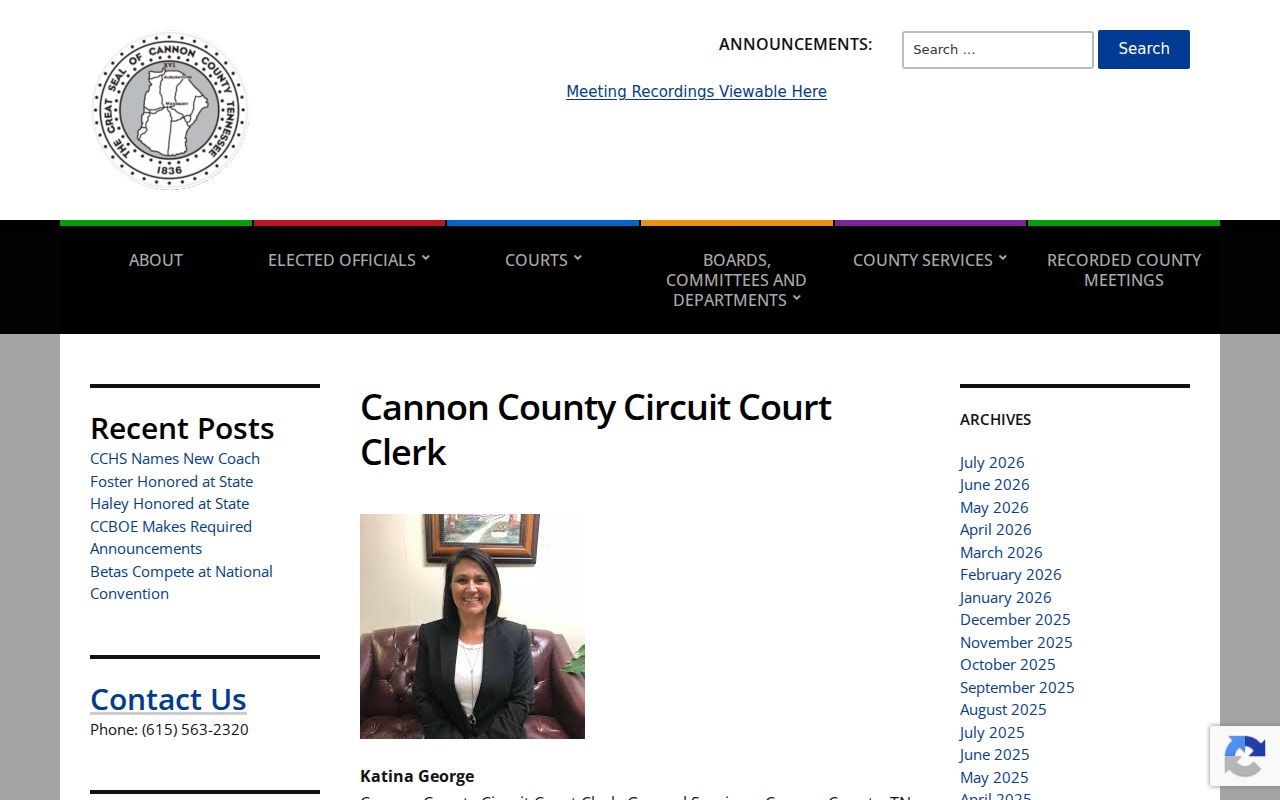
That final-disposition role makes the clerk's certified order the right correction document. FOIL also warns users to confirm information with the jurisdiction that supplied it. Do not infer the outcome from a charge heading, a blank field, or an old third-party copy.
Criminal Records by City in Cannon County
Cannon County has only two incorporated municipalities: Woodbury and Auburntown. The official growth-plan table reports 2022 populations of 2,796 and 276, respectively. Woodbury is the county seat and holds the courthouse, sheriff, and jail, but those remain separate custodians. Auburntown has no official stand-alone police portal, jail, or municipal case-search system located in the research. City or state reports still go to the agency that created them, while prosecution records go to the Cannon County clerk.
Woodbury Criminal History
Population 2,796 · City reports, county booking, and two levels of county court records follow distinct routes.
Auburntown Criminal History
Population 276 · Identify the responding agency, then use the sheriff, state, or Cannon County court channel.
Cannon County CrimeInsight Record Context
Cannon County is small and mostly rural. Census QuickFacts gives the 2025 estimate as 15,296, while the county's official growth-plan draft shows that the two incorporated municipalities account for about one-fifth of residents. That geography makes the Sheriff's Office the likely record source for much of the county. A city-only search can therefore miss sheriff activity and county court cases even when the person or event has a Woodbury or Auburntown mailing address.
The official TBI CrimeInsight portal is the right source for reported crime statistics.
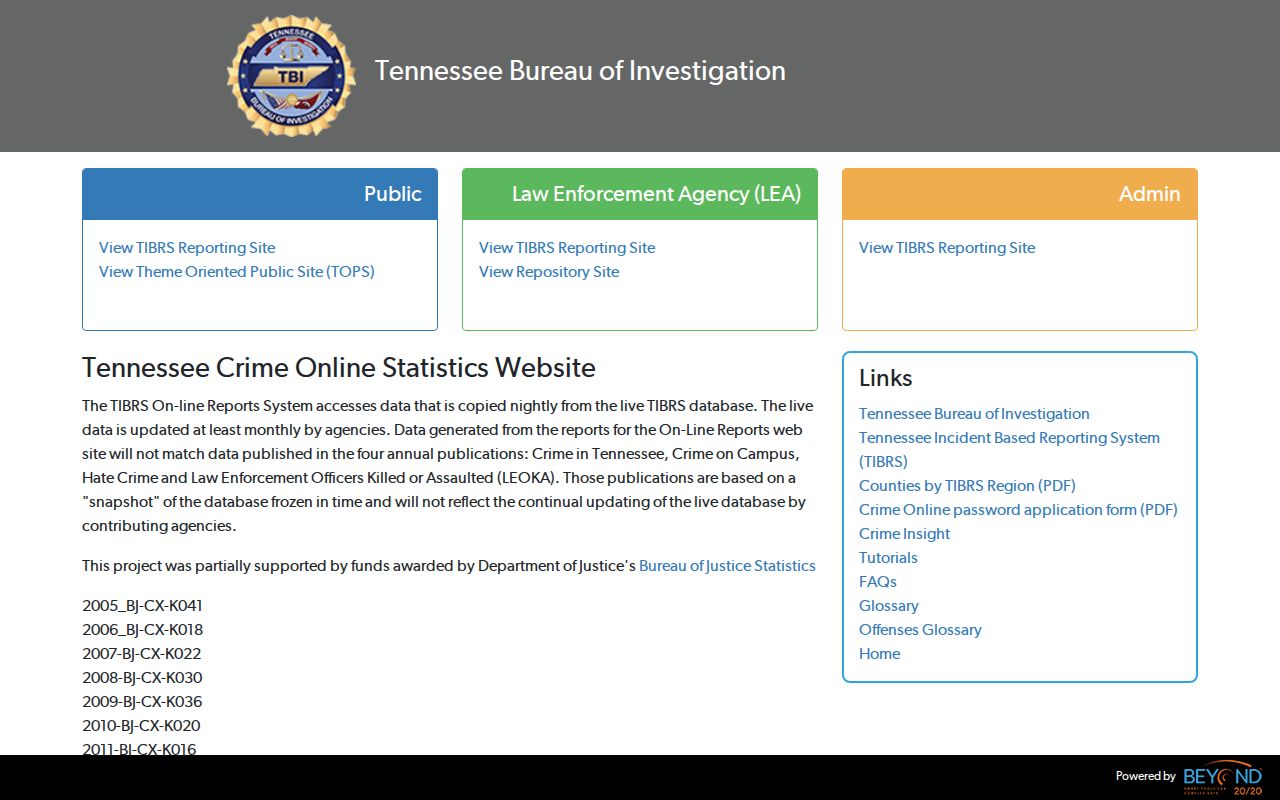
CrimeInsight should be filtered by year, offense, and reporting jurisdiction, such as Cannon County Sheriff's Office or Woodbury Police Department. Its counts describe reported incidents or offenses under TIBRS definitions. They are not conviction totals, and a clearance rate is not a conviction rate. Keep the exported report title and date with any figure. No defensible static Cannon County 2024 total was available from the indexed source, so an unsourced number should not fill the gap.